The AI Growth Loop: Turn Content Into a Revenue System
Most D2C teams use AI to make more content. That’s the wrong leverage point.
The brands pulling ahead in 2026 aren’t publishing more. They’re learning faster. Every piece of content teaches the next one what to do: which hooks to keep, which CTAs to rewrite, where the funnel is leaking, and what to fix in onboarding before the next cycle.
That feedback loop is the actual edge. Not AI content. AI-guided learning systems.
This is the operating model we use at Gemoniq, and it’s the one we’ve seen produce compounding returns across the D2C accounts we manage. Here’s the full framework.
In this article:
- Why volume alone plateaus
- The AI Growth Loop (core framework)
- The Three-Layer Diagnosis Framework — where to look when performance drops
- Hook decay and portfolio rotation — the 50/30/20 method
- Post-click continuity — why great ads still fail
- The 7-day operator sprint — the weekly execution cadence
- How Gemoniq runs this loop
Why volume alone plateaus
Most teams run a version of this workflow:
- Generate content ideas with AI
- Produce assets faster
- Publish more frequently
- Hope volume creates results
This can increase output, but it almost never compounds because it skips the step that matters: diagnosis. You can publish 100 posts and learn almost nothing if your system doesn’t answer:
- Was this a hook problem or a distribution problem?
- Did the CTA match user intent from the ad?
- Did onboarding absorb intent or leak it?
- Which creative pattern is rising and which one is decaying?
The Core Problem
Without a learning loop, AI just helps you waste money faster. Volume without diagnosis is expensive noise.
The AI Growth Loop (core framework)
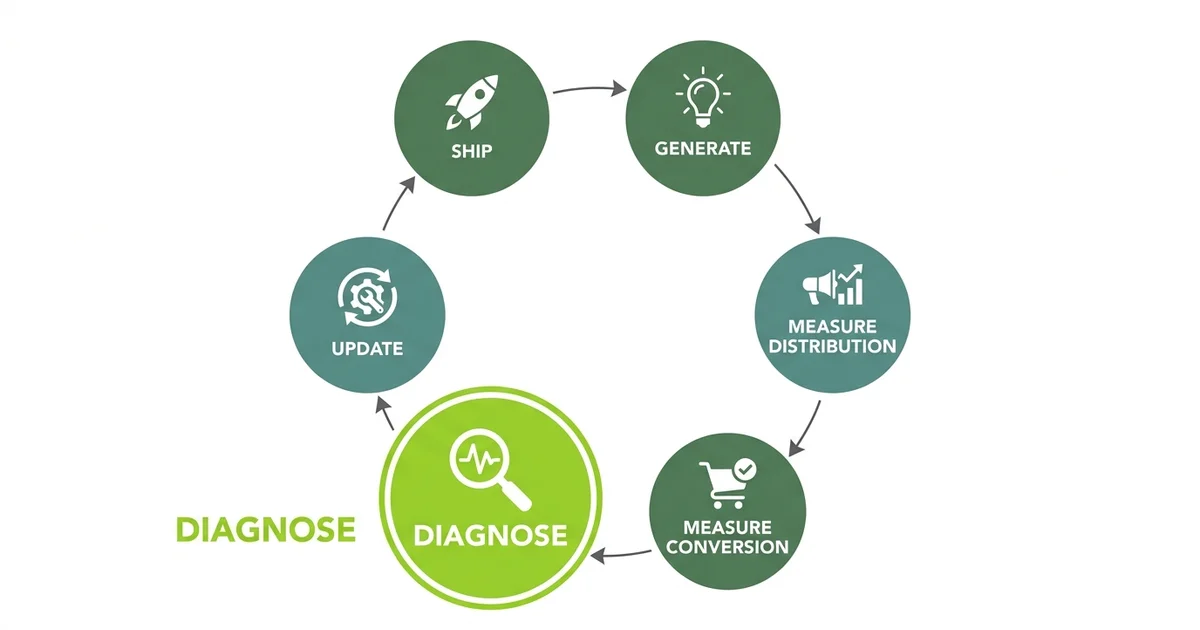
The model that actually compounds has six steps, and the critical difference is that step 4 exists:
Generate
Create multiple content variants — hooks, formats, proof styles. Not one hero piece. A portfolio.
Measure Distribution
Read distribution signals: views, saves, comments, hold rate, retention proxies. Is anyone seeing this?
Measure Conversion
Read conversion signals: clicks, installs, activation starts. Are they taking the next step?
Diagnose (the hinge point)
Identify which layer is leaking. This is where the money is — not in the generate step.
Update
Rewrite creative, CTA, and post-click flow based on diagnosis. Every change is evidence-based.
Ship
Launch the next cycle with those learnings baked in. The loop restarts — sharper every time.
This is a learning system, not a publishing calendar. Every cycle makes the next one sharper. The generate step gets all the attention, but the diagnose step is where the money is.
The Three-Layer Diagnosis Framework
This is the most immediately useful part of the model. When performance disappoints, most teams default to “let’s try different creative.” That’s only the right answer one-third of the time.
Use this triage to figure out where the actual problem lives:
Layer 1: Distribution — are people seeing it?
Signals: reach, views, saves, shares, comments, watch/hold proxies
If this layer is weak, the problem is almost always in the first 1-3 seconds:
- Hook isn’t interrupting the scroll
- Opening structure doesn’t match platform-native patterns
- Format feels foreign to the feed (too produced, wrong aspect ratio, missing captions)
Real-World Pattern
We’ve managed accounts where a simple format change — same message, same offer, but switching from a static image to a slideshow — doubled reach overnight. The content wasn’t the problem. The container was.
Layer 2: Conversion intent — are they taking the next step?
Signals: profile clicks, link clicks, landing page engagement, install/start rate
If Layer 1 is strong but Layer 2 is weak, the issue is in the handoff:
- CTA is vague or buried
- The promise in the content doesn’t match what the click leads to
- Transition friction is too high (too many steps, unclear value at destination)
The Most Misdiagnosed Pattern
High views with low click-through is one of the most common patterns we see. Teams rewrite the entire ad when the only problem is the CTA. Changing “Learn more” to “See the starter kit — $29” can shift CTR by 30-50% with zero change to the creative itself.
Layer 3: Revenue realization — are they paying and staying?
Signals: onboarding completion, activation events, paid conversion, churn
If users arrive but revenue doesn’t follow, stop rewriting the ad. The leak has moved downstream:
- Onboarding doesn’t deliver on the ad’s promise fast enough
- Activation path has too much friction
- Offer structure doesn’t match the intent that brought them in
The Diagnosis Shift That Saves Months
Teams lose months cycling through creative variants when the real problem is that onboarding drops 60% of the traffic the ads are successfully delivering. The shift from “our ads aren’t working” to “our ads are working but our landing page isn’t catching them” can save months and significant budget.
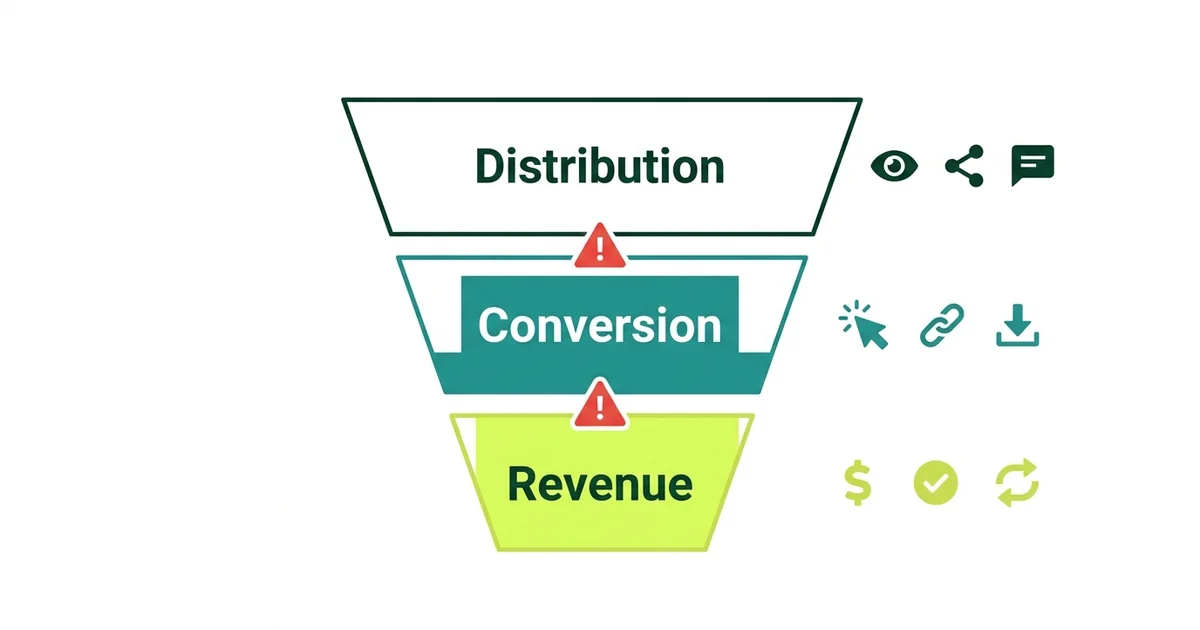
The single most valuable thing this framework does is prevent you from solving the wrong problem. If you’re rewriting hooks when the leak is in onboarding, you’re optimizing the wrong layer.
Find Your Funnel Leak in 15 Minutes
We'll run a free diagnostic across all three layers and show you exactly where your content performance is breaking down.
Hook decay: why portfolio rotation is mandatory
Every hook has a shelf life. This is one of the most consistent patterns across accounts we manage: a hook structure that performs well for the first 3-5 posts, then starts declining noticeably — sometimes dropping to half its original performance within a week.
This isn’t a failure. It’s normal lifecycle behavior. The audience that responds to that hook gets saturated, and the algorithm starts finding diminishing pockets of new reach.
The mistake is running one winner until it dies, then scrambling to find the next one. That creates boom-bust cycles instead of steady performance.
The 50/30/20 split (weekly)
Treat hooks like a managed portfolio:
| Bucket | Allocation | Purpose |
|---|---|---|
| Scale | 50% | Current winning hook families — these are paying the bills |
| Bridge | 30% | Close variants of winners — same emotional territory, different angle |
| Explore | 20% | Genuinely new narrative bets — your pipeline for when winners decay |
Execution pattern:
- 2-3 base hook families active at any time
- 3 format variants per family
- Fixed CTA mapping per variant (so you can isolate hook performance from CTA performance)
- Written notes on what changed between variants (so diagnosis is possible, not just vibes)
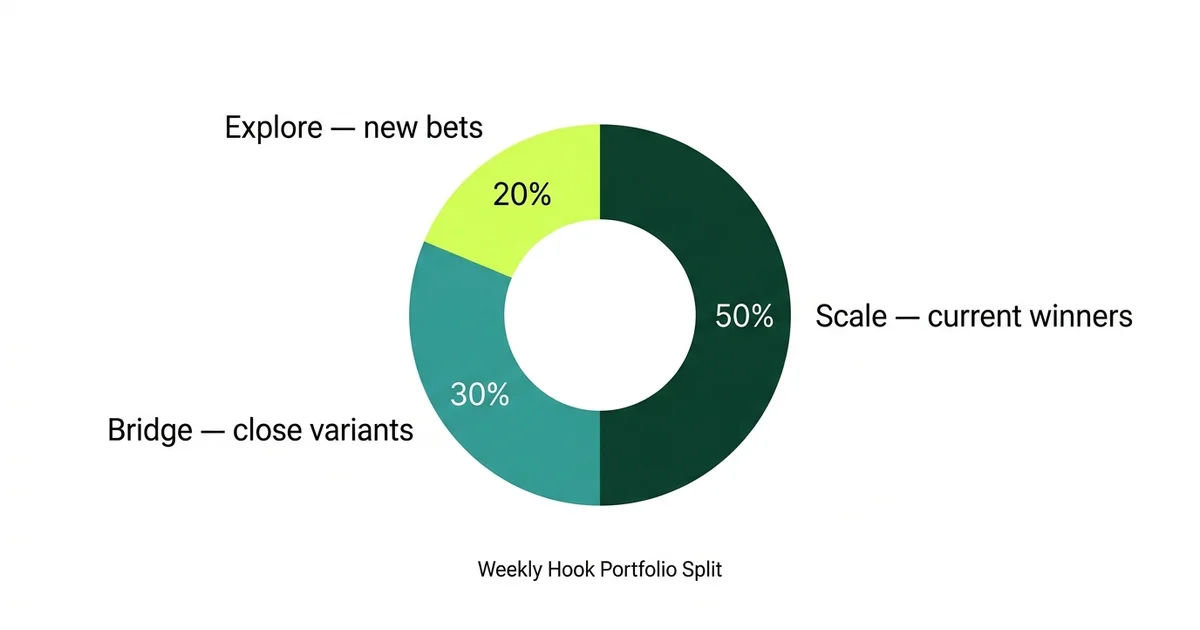
Now every post is a structured experiment, not a random asset. And when a hook family starts decaying, you already have bridge and explore variants in the pipeline ready to take over.
Post-click continuity: where revenue is actually won or lost
Strong creative means nothing if the click lands somewhere that breaks the promise.
This is the pattern: a team produces a great ad with a specific hook (“14 formulations. 8 months. My dermatologist thought I was insane.”) and the click leads to a generic product page that says “Premium skincare for modern women.” The specificity that earned attention disappears at the moment of decision. Trust breaks. CPA rises.
Minimum Continuity Checks
- The core promise from the hook appears in the first fold of the landing page
- The emotional context carries through from ad to destination
- Proof elements appear near decision points, not buried at the bottom
- The CTA at destination is specific and low-friction
- Onboarding delivers on the ad’s promise within the first session
When this alignment is strong, the same traffic becomes more profitable without spending more on acquisition.
For the creative production side — what kind of ads to make, how to test them, and why raw human-feeling creative is outperforming polished production — read The Human Ads Playbook: Why ‘Ugly’ Creative Is Winning.
For a deep dive on creating ad visuals without a designer (AI tools, Canva workflows, product photography) — see How to Create Winning Ad Creatives Without a Designer.
The 7-day operator sprint
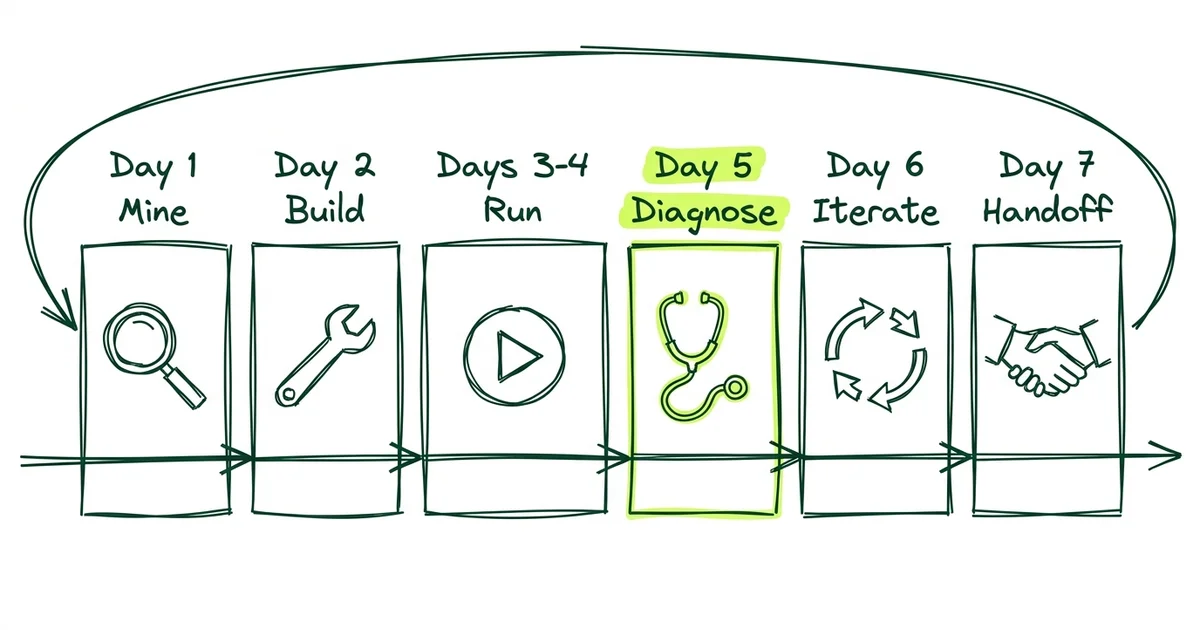
Use this cadence to turn one-off content into a compounding system:
Day 1 — Pattern mining. Pull the top 10-15 performing posts in your niche from the last 14 days. For each one, extract: hook structure (question/statement/provocation), proof format (testimonial/demo/data), CTA placement and type. You’re building a pattern library, not copying posts.
Day 2 — Variant build. Create 8-12 variants across your 50/30/20 buckets. For each variant, write the explicit hypothesis: “This tests whether [problem framing] outperforms [aspiration framing] with the same proof structure.” Map each variant to a specific CTA.
Day 3-4 — Distribution run. Publish and track by variant family, not just by individual post. Tag everything so you can compare hook families against each other. Monitor early signals (first 2 hours of saves, comments, hold rate).
Day 5 — Bottleneck diagnosis. For each variant, tag the failure layer:
| Failure Type | Signal | Problem |
|---|---|---|
| Distribution failure | Low views/reach | Hook or format problem |
| Conversion failure | Strong views, low clicks | CTA or promise-match problem |
| Retention failure | Clicks but no revenue | Onboarding or offer problem |
This single step is what separates publishing from learning.
Day 6 — Iteration pass. Rewrite next batch from winning structures. Update CTAs based on Day 5 findings. Check landing page continuity against top performers. Kill hook families that have decayed across 3+ consecutive posts.
Day 7 — Product handoff. Push the top friction findings from your diagnosis into the onboarding or activation flow. Share specific findings with product: “Users who arrive from [hook type X] drop off at [onboarding step Y].” This is the step that makes the loop a revenue system instead of a content calendar.
Then reset the test matrix and start the next cycle.
What this means for D2C teams right now
Short-form content and paid performance can’t run as separate functions anymore. The teams building durable advantage are merging three disciplines into one operating system:
- Creative velocity from short-form content production
- Measurement discipline from paid media operations
- Funnel continuity from conversion optimization
When those three are linked, content stops being a cost center and starts behaving like a compounding revenue system. Every cycle teaches the next one.
“The future isn’t AI-generated content at scale. The future is AI-guided growth loops that continuously improve creative, conversion, and retention together.
”
If your main KPI is still “posts published,” you’re measuring effort, not learning. Measure learning velocity and revenue impact instead.
How Gemoniq runs this loop for D2C brands
This isn’t a theoretical framework. It’s the operating model inside Gemoniq’s platform.
We run Meta Ads end to end for D2C brands, which means every step of the loop happens inside one system:
Campaign Planning
Angles, audience intent mapping, offer structure — all informed by previous cycle data.
Creative Execution
Variant production and launch orchestration directly to Meta Ads Manager.
Data Analysis
Distribution, conversion, and drop-off diagnostics across all three layers.
Optimization
Hook rotation, CTA continuity fixes, and post-click recommendations fed back into the next cycle.
Your ad account becomes a learning system that compounds, not a content factory that burns budget.
Get Your Growth Audit
We'll map exactly where your current funnel is leaking and show you how to turn your ad account into a compounding system.
Architectural Intelligence
Get the weekly newsletter on design-led performance marketing, directly to your inbox.
No spam. Just intelligence. Unsubscribe anytime.