Content-to-Commerce: Turn Organic Posts Into Paid Winners
Most D2C brands treat organic social and paid ads as separate functions. Different teams, different content, different goals. Organic is for “brand building.” Paid is for “performance.” The two rarely talk to each other.
This is leaving money on the table every week.
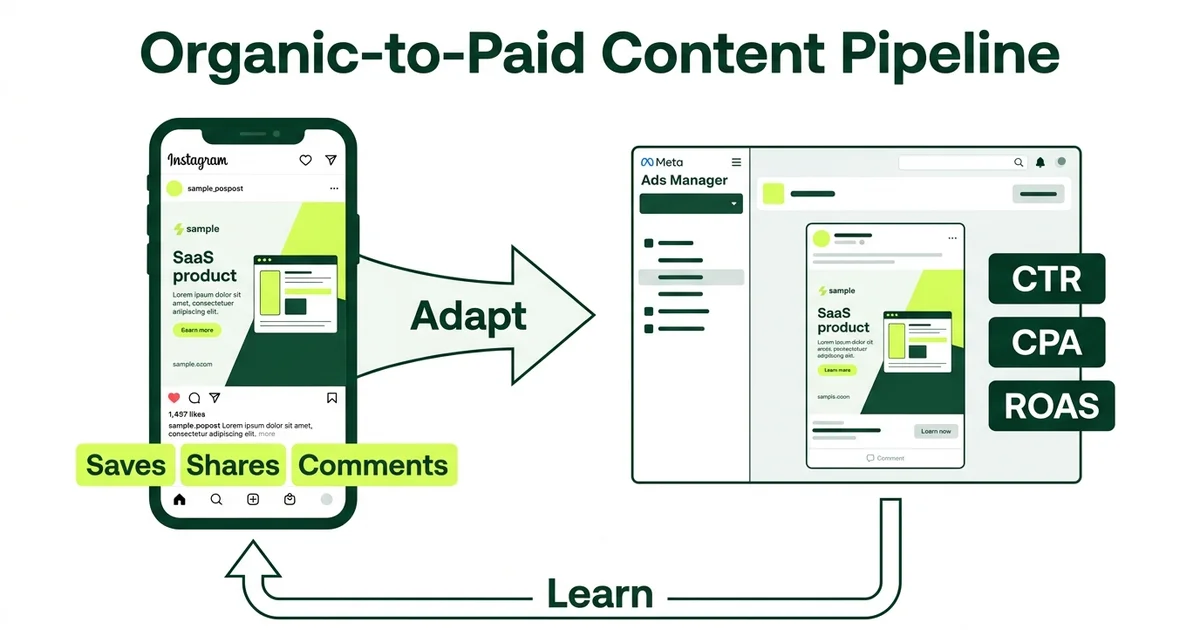
The brands that are growing fastest in 2026 use organic as a testing lab for paid. They publish content, watch what resonates, then take the winners and run them as ads. The organic audience tells you what works before you spend a dollar on distribution.
This is not a new idea. But most teams execute it badly because they skip the translation step. They take a post that worked organically, boost it or turn it into an ad without adapting it, and wonder why it underperforms. Organic and paid are different environments with different rules. The content needs to be adapted, not just reposted.
Here is the system for doing it right.
In this article:
- Why organic-first content strategy wins on paid
- The signals that predict paid performance
- The 4-step translation process
- Three formats that cross over best
- Common mistakes that kill the crossover
- The weekly organic-to-paid pipeline
Why organic-first content strategy wins on paid
There are three structural advantages to using organic content as your paid creative source:
1. Pre-validated hooks. When a post performs well organically, the hook has been tested against a real audience with zero distribution budget. The algorithm showed it to a small audience, they engaged, and the algorithm showed it to more people. That is a market test. When you put budget behind that same hook, you are amplifying something that already proved it can earn attention.
2. Lower production cost. The content already exists. You are not starting from scratch. The adaptation work (which we will cover below) takes a fraction of the time and cost of producing new ad creative from nothing. For teams running the 50/30/20 hook portfolio, organic winners feed directly into the “Scale” bucket.
3. Native format advantage. Organic content that performs well already looks and feels like platform-native content. That is exactly the trust-efficient creative that outperforms polished production on Meta and TikTok. You do not need to make it look more “professional” for paid. In fact, doing so usually hurts performance.
The organic testing lab
Think of your organic feed as a free focus group that runs 24/7. Every post is a hypothesis about what your audience cares about. The engagement data tells you which hypotheses are correct. Paid amplifies the correct ones.
The signals that predict paid performance
Not every organic hit will work as a paid ad. Virality and commercial intent are different things. A meme might get 10,000 likes but sell nothing. A product demo might get 200 likes but every viewer is a potential buyer.
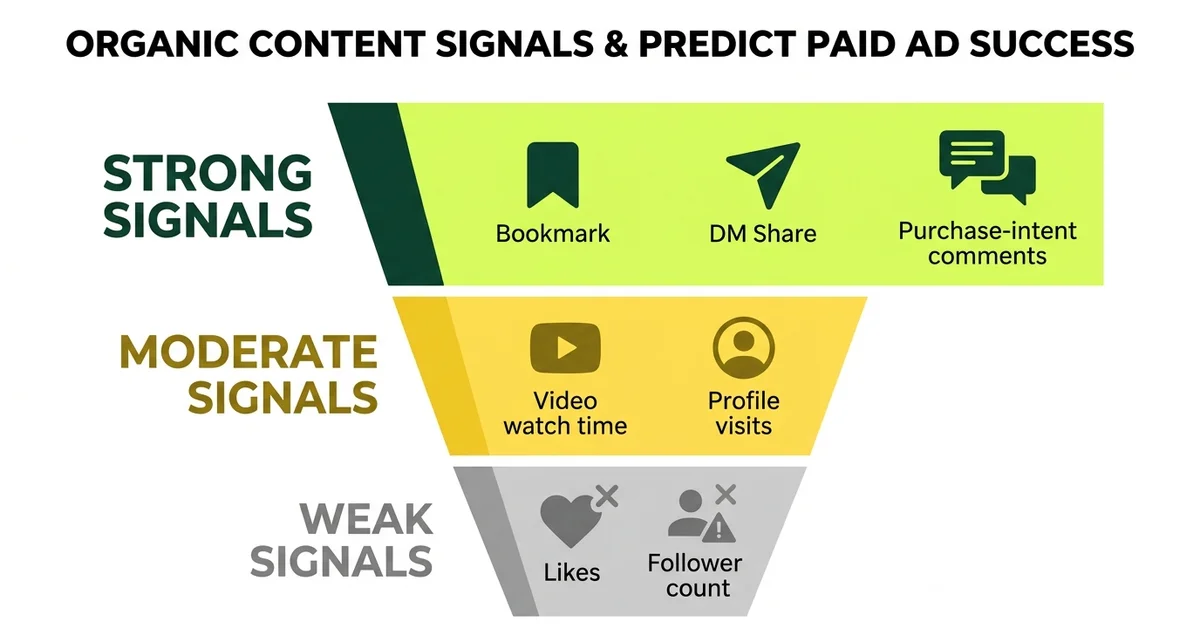
Here are the signals that predict whether an organic post will convert as a paid ad:
Strong signals (high confidence)
Save rate above 3%. Saves are the strongest buying intent signal on Instagram and TikTok. When someone bookmarks your content, they are telling you: “I want to come back to this.” That is purchase consideration behavior. Posts with high save rates almost always outperform as ads.
DM shares. When people share your post to a friend via DM, they are doing your sales work for you. They are saying “you need to see this” to someone in their network. High DM share rate means the content has referral energy, which is the most valuable kind of social proof.
Comment quality. Not comment volume. Read the actual comments. Are people asking “where do I buy this?” or “what’s the price?” or tagging friends? Those are commercial signals. Are they just saying “great post” or dropping emojis? That is engagement without intent.
Moderate signals (worth testing)
High hold rate on video. If people watch 75%+ of a video, the content held their attention. That does not guarantee they will buy, but it means the hook and narrative structure work. Worth testing as an ad with a stronger CTA added.
Profile visits. If a post drives profile visits, people want to know more about you. That curiosity is a step toward purchase intent. Not as strong as saves or DM shares, but a positive indicator.
Weak signals (do not rely on)
Like count. Likes are free, reflexive, and do not correlate with purchase behavior. A post with 5,000 likes and 10 saves is entertainment, not commerce.
Follower growth. New followers from a viral post are often low-quality. They followed because of one piece of content, not because they are in your target market. Do not assume follower spikes mean you found a winning ad angle.
“Save rate is the single best predictor of organic-to-paid crossover success. If people are bookmarking it, they are considering buying. If they are just liking it, they are just scrolling.
”
The 4-step translation process
This is the process for adapting organic winners into paid creative without killing what made them work.
Identify the winner (weekly)
Every Monday, pull the top 3 to 5 organic posts from the previous week by save rate and DM shares. Do not sort by likes or reach. Those metrics measure entertainment value, not commercial value. Look at the posts your audience found worth saving.
Extract the winning element
For each winner, identify the specific element that drove performance. Was it the hook? The proof point? The format? The emotional angle? Be precise. “The post did well” is not useful. “The hook worked because it named a specific frustration that our audience has” is useful. This extraction is what makes the next step possible.
Adapt for paid (not copy)
This is where most teams fail. They take the organic post and boost it or run it as-is. That rarely works because organic and paid have different requirements:
Add a clear CTA. Organic posts often work without a CTA because the goal is engagement. Paid posts need a specific action: “Shop the starter kit,” “Get the free guide,” “Book a demo.” Use the CTA specificity principles from our continuity framework.
Tighten the hook. Organic hooks can be slower because the viewer chose to follow you. Paid hooks need to work in the first 1 to 2 seconds on people who have never seen your brand. Keep the core angle but make the opening more direct.
Ensure landing page continuity. The ad needs to link somewhere that continues the promise. If the organic post was about a specific product benefit, the landing page should lead with that benefit, not your homepage. Review the full continuity checklist.
Maintain the format. If the organic post worked as a carousel, test it as a carousel ad. If it worked as a talking-head video, run it as a talking-head video ad. Do not convert a carousel into a static image or a video into a graphic. The format is part of why it worked.
Test and measure against fresh creative
Run the adapted organic winner alongside your regular ad creative in the same campaign. Give both equal budget for 3 to 5 days. Compare:
- Hold rate (is the hook working in a paid context?)
- CTR (is the CTA driving clicks?)
- Conversion rate (is the landing page converting the traffic?)
- CPA (is the full funnel working?)
If the organic-adapted creative outperforms, scale it into your “Scale” bucket. If it underperforms, the winning element from organic did not translate. That is useful data too: it tells you the post resonated with your existing audience but not with cold audiences.
Three formats that cross over best
Based on the accounts we manage at Gemoniq, these three organic formats have the highest crossover success rate to paid:
1. Founder or team member talking to camera
This is the single best crossover format. A founder explaining why they built the product, how it works, or sharing a specific result consistently outperforms produced ad creative when adapted for paid. It works because it combines authority, specificity, and trust-efficient creative in one format.
Adaptation for paid: Add a CTA card at the end. Tighten the first 2 seconds. Add captions if not already present. Link to a product page that mirrors the specific benefit discussed in the video.
2. Before/after or transformation content
Showing real results with real specifics. Not stock photos or generic claims. A skincare brand showing a real customer’s skin at week 1 and week 8. A fitness brand showing actual measurements. A SaaS brand showing a dashboard before and after using the product.
Adaptation for paid: Add context in the first frame (“Real results, no filter”). Include the product name and price in the final frame. Link to a landing page with more transformations and a clear purchase path.
3. “How I use this” or routine content
Posts that show the product in context of a real person’s daily routine or workflow. “My morning skincare routine” or “How I set up my weekly campaign” or “3 ways I use [product] that changed everything.” These work because they show the product solving a real problem in a relatable way.
Adaptation for paid: Frame the hook as a problem-solution (“I used to waste 2 hours on this. Now it takes 10 minutes.”). Keep the authentic, unscripted feel. Add a specific CTA that matches the use case shown.
Want Help Building Your Organic-to-Paid Pipeline?
We will analyze your organic content, identify the posts with the highest paid potential, and build the first batch of adapted ad creative. Free strategy call.
Common mistakes that kill the crossover
Over-polishing the winner
The organic post worked because it felt real. If you hand it to a production team who adds motion graphics, professional voiceover, and a brand outro, you have destroyed the thing that made it perform. The human ads playbook applies here: raw outperforms polished on Meta and TikTok.
Ignoring the audience gap
Your organic audience already knows and trusts you. Cold paid audiences do not. An organic post that references an inside joke, assumes knowledge of your brand, or skips the “who we are” context will confuse cold viewers. Add a brief context frame at the beginning for paid: one sentence that tells a stranger what this brand is and why they should care.
Boosting instead of building
Instagram’s “Boost Post” button is a trap. It optimizes for engagement (likes, comments) not conversions (purchases, sign-ups). Instead, take the organic content, adapt it using the 4-step process above, and run it as a proper ad through Meta Ads Manager with conversion-optimized campaign settings.
Not matching the landing page
We keep coming back to this because it keeps being the problem. The organic post talks about a specific benefit. The ad links to your homepage. The visitor cannot find the thing they clicked for. Review the continuity audit before launching any adapted creative.
The weekly organic-to-paid pipeline
Here is the cadence that turns this from an occasional tactic into a systematic advantage:
Monday: Mine Pull top performers from the previous week. Sort by save rate and DM shares. Identify the top 3 to 5 candidates. This feeds directly into Day 1 of the 7-day operator sprint.
Tuesday: Extract and adapt For each candidate, document the winning element. Adapt the content for paid using the 4-step process. Ensure landing page continuity for each adapted piece.
Wednesday: Launch Add adapted creative to existing campaigns alongside current ads. Use the same targeting and budget allocation. Set up tracking to compare organic-adapted vs. fresh creative.
Friday: Read After 3 days of data, evaluate each adapted creative using the 3-Layer Diagnosis. Is it getting distribution (Layer 1)? Is it driving clicks (Layer 2)? Is it converting (Layer 3)?
Following Monday: Decide Scale winners into the regular ad rotation. Kill underperformers. Feed the learnings back into your organic content strategy: what works on paid probably works on organic too, and vice versa.
This creates a feedback loop between organic and paid that makes both channels smarter over time. Organic discovers what resonates. Paid amplifies the winners. Paid data reveals which organic angles have commercial value. Organic tests new angles informed by paid performance.
The compound effect
After 4 to 6 weeks of running this pipeline, you will know more about what your audience responds to commercially than most brands learn in a year. Every week adds data. Every cycle makes the next one more efficient. This is the AI Growth Loop applied to content strategy.
How Gemoniq runs this for D2C brands
The organic-to-paid pipeline is one component of the full growth loop we operate for D2C brands. At Gemoniq, this process is built into the weekly cadence:
- Organic performance scanning identifies the posts with the strongest commercial signals across Instagram, TikTok, and other platforms
- Creative adaptation translates winners into ad-ready formats with proper CTAs, hooks, and landing page alignment
- Campaign integration runs adapted creative alongside existing ads in Meta Ads Manager with proper attribution
- Diagnostic feedback uses the 3-Layer framework to determine whether adapted creative is winning on distribution, conversion, or revenue
- Cross-channel learning feeds paid performance data back into organic content strategy
The result is a content engine where organic and paid reinforce each other instead of operating in silos.
Start Turning Your Best Content Into Revenue
We will audit your organic content, identify your highest-potential posts, and show you exactly how to adapt them for paid. Free, 30 minutes.
Architectural Intelligence
Get the weekly newsletter on design-led performance marketing, directly to your inbox.
No spam. Just intelligence. Unsubscribe anytime.